
First in Freedom: Camp Flintlock at the 250th Anniversary of Moores Creek Bridge

Updated: May 28
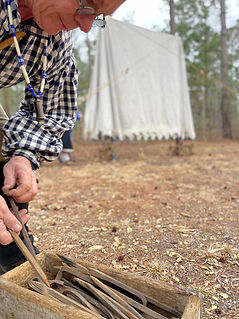
For three rainy February days, Camp Flintlock packed up our tents, quills, drums, and printing blocks and headed east to commemorate one of North Carolina’s most important Revolutionary War anniversaries — the 250th Anniversary of the Battle of Moores Creek Bridge.
If you ask most people where the American Revolution began, they’ll usually answer Lexington and Concord.
But months before the Declaration of Independence was signed, North Carolina was already making history.
Fought on February 27, 1776, the Battle of Moores Creek Bridge was the first decisive Patriot victory of the American Revolution and helped convince North Carolina to become the first colony to authorize its delegates to vote for independence — earning our state the nickname “First in Freedom.”
For Camp Flintlock, this anniversary was more than a reenactment weekend.
It was a chance to help visitors experience history the way we believe it should be experienced — by touching it, hearing it, and doing it.
Throughout the weekend, we offered demonstrations in Quill & Ink writing, block printing, and Revolutionary-era fife and drum music, inviting visitors to try skills that children and adults alike would have used more than 250 years ago.

One especially memorable visitor to our camp was bestselling author Diana Gabaldon, creator of the Outlander series.
Readers of Outlander may recognize Moore’s Creek Bridge from the novels, where Jamie and Claire Fraser eventually settle in North Carolina and become deeply involved in the events surrounding the Revolution. Jamie himself participates in the Battle of Moore’s Creek Bridge, making the battlefield an especially meaningful place for many readers.
During her visit to the living history area, Diana stopped by our camp and joined us for one of our favorite activities — writing with a feather quill and ink.
Watching someone experience quill writing for the first time is always entertaining. There is something about dipping the pen, blotting excess ink, and slowly forming each letter that immediately connects people to the past. It reminds us that history is made up of ordinary moments as much as famous battles.
For me personally, the weekend carried an even deeper meaning.

Two of my ancestors fought at Moore’s Creek Bridge, including Abraham Newkirk, a private in the First North Carolina Regiment under Colonel James Moore.
Standing inside the visitor center and seeing Abraham Newkirk’s saber displayed in the museum was one of those rare moments where history suddenly feels very small and very personal.
Family tradition says Abraham returned from Moore’s Creek with the saber after the battle. Historians believe it originally belonged to a friend before eventually passing into the Newkirk family, where it remained for generations. Today it sits behind museum glass — a quiet reminder that the people who fought here were real people with families, stories, and descendants still walking these battlefields 250 years later.

Despite rain, mud, and soggy shoes, thousands gathered throughout the weekend to honor the soldiers who fought here and the events that helped shape our country.
Events like this remind us why living history matters.
History is not simply memorizing dates or names. It is understanding the choices people made, trying the skills they used, hearing the music they played, and realizing that the past was lived by ordinary people not so different from ourselves.
That is the experience we strive to create every day at Camp Flintlock — whether through field trips, camps, or public events.
Because sometimes the best way to understand history… is to pick up the quill yourself.
Comments