
The Real Story Behind “Sleep Tight, Don’t Let the Bedbugs Bite”

Have you ever heard someone say:
"Sleep tight, don't let the bedbugs bite?"
It's a phrase many of us grew up hearing, but did it really come from colonial America?
The answer is a little complicated.
What Did Colonial Beds Look Like?
Most colonial families did not sleep on the large mattresses we use today.

Instead, many beds were built with a wooden frame and a network of ropes stretched tightly across the bottom.
These ropes created a support system for the mattress, which was often a tick—a fabric sack stuffed with straw, feathers, wool, corn husks, or other materials.
Over time, the ropes would loosen under the weight of the sleeper.
When that happened, the mattress would sag.
To make the bed comfortable again, the ropes had to be tightened.
Some families even used a special tool called a rope key or bed wrench to pull the ropes tighter.
A properly tightened bed provided better support and a more comfortable night's sleep.
Did "Sleep Tight" Come From Rope Beds?
Maybe.
Many people believe the phrase "sleep tight" comes from these rope-supported beds.
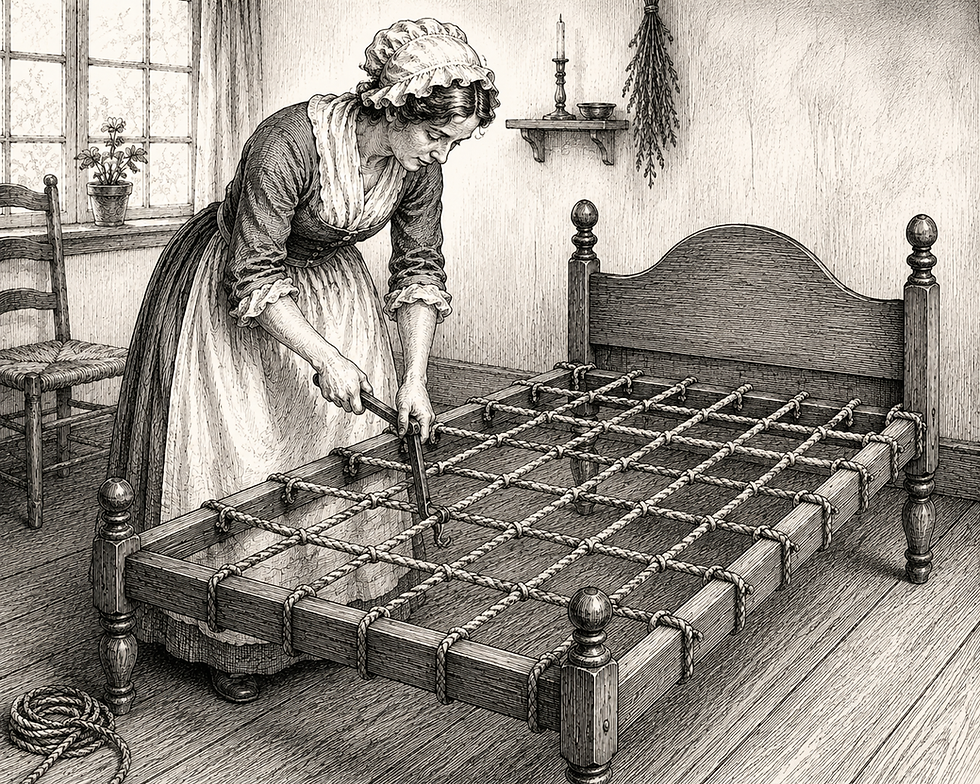
The idea is simple: if the ropes were pulled tight, you would sleep more comfortably.
It is a great story, and it certainly sounds possible.
However, historians have never found definitive proof that the phrase originated from colonial rope beds.
The phrase "sleep tight" does not appear in written records until much later, during the 1800s.
Some language experts believe the word tight simply meant soundly or well, much like saying "sleep well" today.
So while the connection to rope beds is popular, we cannot say for certain that it is the true origin.
Rope Was Everywhere in Colonial America
Whether supporting a mattress or rigging a ship, rope was one of the most important tools in colonial life.
Colonists used rope to lower buckets into wells, hang meat in smokehouses, drive spinning wheels, secure wagon loads, pitch tents, tether livestock, and support window sashes. Farmers, sailors, soldiers, and tradesmen all depended on strong cordage every day.

The materials varied depending on what was available. Hemp was one of the most valuable fibers used for rope making, and colonial governments actively encouraged its cultivation because rope was essential for shipping, trade, farming, and military supplies.
Native Americans also made strong cordage from local plants and shared valuable knowledge about fibers found throughout North America. Early European settlers learned much from Indigenous peoples about using native materials effectively.
What About the Bedbugs?
Those were very real.
Long before modern pest control, bedbugs were a common problem throughout Europe and the American colonies.

Unlike fleas, which often arrived with animals, bedbugs preferred to live near people.
They hid in mattresses, cracks in wooden furniture, bed frames, and walls, emerging at night to feed.
Colonial families worked hard to keep them away.
Mattresses were aired out in the sunshine.
Bedding was washed whenever possible.
Bed frames were cleaned and inspected.
Even so, bedbugs remained a frustrating part of everyday life.
A Surprising Revolutionary Connection

Believe it or not, rope makers played a small role in the events leading up to the American Revolution.
In 1770, tensions flared between British soldiers and workers at a Boston ropewalk—a place where rope was manufactured.
Fights between the soldiers and rope makers continued for several days and helped increase tensions in the city. Those tensions eventually contributed to the events surrounding the Boston Massacre.
It's a reminder that history is often shaped by ordinary tradespeople doing everyday work.
Why We Teach Cord Making at Camp Flintlock
Whether the phrase "sleep tight" truly comes from rope beds or not, it gives us a wonderful opportunity to explore an important colonial skill.

At Camp Flintlock, students learn to make their own cords using a simple cord-making jig. As they twist individual strands together, they discover an important principle that colonists understood well: several strands twisted together create a cord that is much stronger than any single strand alone.
Those same cord-making techniques were used throughout colonial America. Ropes and cords helped rig ships, secure loads on wagons, tether livestock, raise tents, and support the rope beds found in many homes.
As students create their own cord, they also learn about the materials colonists used, including hemp, flax, and other natural fibers. Along the way, they discover how something as simple as a piece of rope connected to nearly every part of daily life.
And the next time they hear someone say, "Sleep tight, don't let the bedbugs bite," they'll understand that behind that familiar saying may be a story of rope beds, hardworking colonists, and the cords that helped hold their world together.

Comments